
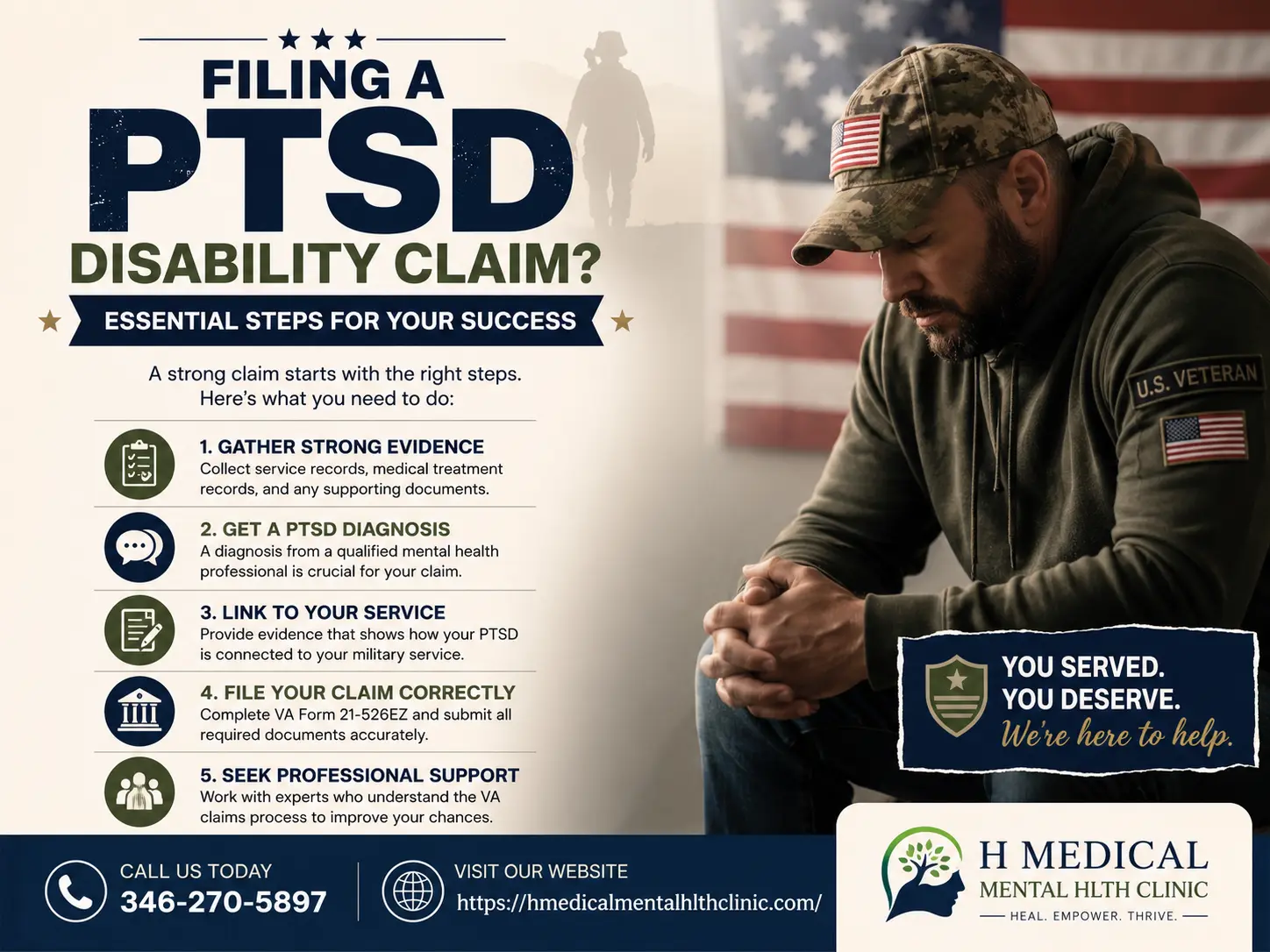
Filing a PTSD Disability Claim? Essential Steps for Your Success
It can be hard to file a PTSD disability claim with the Department of Veterans Affairs (VA), especially if you are already dealing with the effects of trauma in your daily life. You don't have to guess how to get the benefits you earned, though. If you know how the process works, get the right paperwork, and follow a plan, you can make sure your claim is accepted.
Key Takeaways
- You must have a formal diagnosis from a qualified medical professional.
- You need to write down exactly what happened during your service that caused stress.
- The main parts of your claim are medical proof, lay statements, and service records.
- It's important to find a "nexus," or the link between your service and your present situation.
- Learning a lot for your Compensation & Pension (C&P) test will keep your real story from being swept under the rug.
What Is PTSD?
As a result of having or witnessing a traumatic event, some people develop Post-Traumatic Stress Disorder (PTSD). This could mean active fighting, military sexual trauma (MST), accidents in training, or serious threats of harm for veterans. Symptoms often include memories that keep coming back, being too alert, severe anxiety, nightmares, and feeling emotionally numb. These symptoms are not a sign of weakness; they are a direct psychological response to extreme stress. They can make it very hard to keep up with work, social obligations, and daily tasks.
1: Confirm Your PTSD Diagnosis
You need a recent, legal diagnosis of PTSD before you can file. This diagnosis must come from a licensed mental health professional, like a clinical social worker, psychiatrist, or psychologist, in order for the VA to accept it. Self-diagnoses or notes from general practitioners aren't usually enough on their own. Make sure that your doctor uses standard criteria (like the DSM-5) and writes down all of your symptoms.
2: Identify The Stressor Event for your PTSD Disability Claim
What event in your military service caused your PTSD? The VA needs to know. The word for this is "stressor."
- For combat-related PTSD: You usually need to list the date, location, and type of combat.
- For non-combat or MST-related PTSD: Details could include official incident reports, police logs, service medical records, or secondary markers such as sudden requests to be transferred or changes in how well you do your job.
One of the most helpful things you can do is write a clear, thorough personal statement about the thing that caused you stress and how it changed your life.
3: Gather Supporting Evidence for Your PTSD Disability Claim
Claims that are true depend on strong proof. You need to send the VA a full package so they can get a full picture of your mental health journey:
- Medical Records: Such as notes from therapy, hospital stays, past prescriptions, and private mental health care records.
- Service Records: Such as DD-214s, personnel files, performance reviews, and records of travel.
- Buddy Statements: Written accounts from family, friends, coworkers, or other service members who saw changes in your behavior, personality, or mood before and after the stress.
4: Establishing The Service Connection
The VA needs to see a clear "nexus"—a direct link between the event that caused your PTSD and your time in the service—in order to accept your claim. Veterans of combat often get help from an accepted stressor rule, but claims from people who were not in combat need clear proof that the event happened and directly caused your condition. Your case will be much stronger if you have a written Medical Nexus Letter from a seasoned clinical expert saying that your PTSD is "at least as likely as not" caused by your service.
5: File Your PTSD Disability Claim
Send your claim to the VA once all of your proof is in order. There are several ways to file: on VA.gov, by mail with VA Form 21-526EZ, or with the help of a certified Veteran Service Officer (VSO). If you're not ready to turn in all of your paperwork today, you might want to send in an "Intent to File" right away. This sets your effective date and guarantees that you will get back pay from the date it was accepted.
6: Prepare For The C&P Exam
The VA will likely set up a Compensation & Pension (C&P) exam with an approved examiner after looking over your file.
- Be honest and thorough: Don't play down your symptoms because you're proud or embarrassed. Don't talk about your best days; talk about the worst ones.
- Focus on daily functional impairment: how does it affect your job, your relationships, your hygiene, your sleep, your mood?
- Review your notes beforehand: Bring a copy of your stressor statement and symptom notes with you to the interview to make sure you don't forget important information.
7: Understand The Rating and What Comes Next
The VA gives PTSD scores on a scale from 0% to 100%, usually in 10%, 30%, 50%, 70%, or 100% steps, based on how much it affects your work and social life.
- If approved: Look over your rating decision again to make sure it matches your real level of disability.
- If denied or under-rated: Many cases are turned down at first, but are later accepted after being appealed to Higher-Level Reviews, Supplemental cases, or the Board of Veterans' Appeals.
Common Mistakes to Avoid
- Waiting too long to submit an Intent to File: Waiting too long means losing out on possible back pay.
- Downplaying symptoms at the C&P exam: Trying to look and act "fine" during a test brings down the rating of disability.
- Filing without a formal diagnosis: If you rely on self-reporting without clinical support, you will almost certainly be denied.
- Missing appointments: If you don't show up for your scheduled C&P exam, your claim will be denied right away.
Get Expert Support from Houston Medical-Mental Health Clinic
You shouldn't have to go through mental health exams and VA papers by yourself. Our skilled clinicians at Houston Medical-Mental Health Clinic are experts in doing full psychiatric evaluations, official PTSD diagnoses, independent medical tests, and detailed Nexus Letters. We know the exact clinical language that the VA needs, so we can help you make a claim that is clear, based on evidence, and true to your experience. Get in touch with our team right away to set up a test and take the next step toward getting your benefits.
Frequently Asked Questions
Can I get a PTSD rating if I didn't serve in combat?
Yes, veterans who did not fight can be diagnosed with PTSD if they experienced sexual trauma in the military, serious training accidents, natural disasters, or seeing traumatic injuries or deaths. But the level of proof needed to show that the non-combat stressor event happened is usually greater.
What is the average VA rating for PTSD?
Ratings are based on each person's symptoms, but a lot of veterans get a 50% or 70% disability rate. A rating of 70% usually means that the person has a lot of trouble at work, with social interactions, and with controlling their emotions.
What is a Nexus Letter, and do I need one for my PTSD claim?
A qualified medical professional writes a formal Nexus Letter to link your PTSD to an event from your military service. While the law does not require a strong Nexus Letter, having one greatly increases your chances of approval, especially in non-combat cases.